

Translating Bitcoin ETF Options Income from Theory to Structured Practice
A Practitioner’s Perspective on Frameworks, Tools, and Execution Discipline

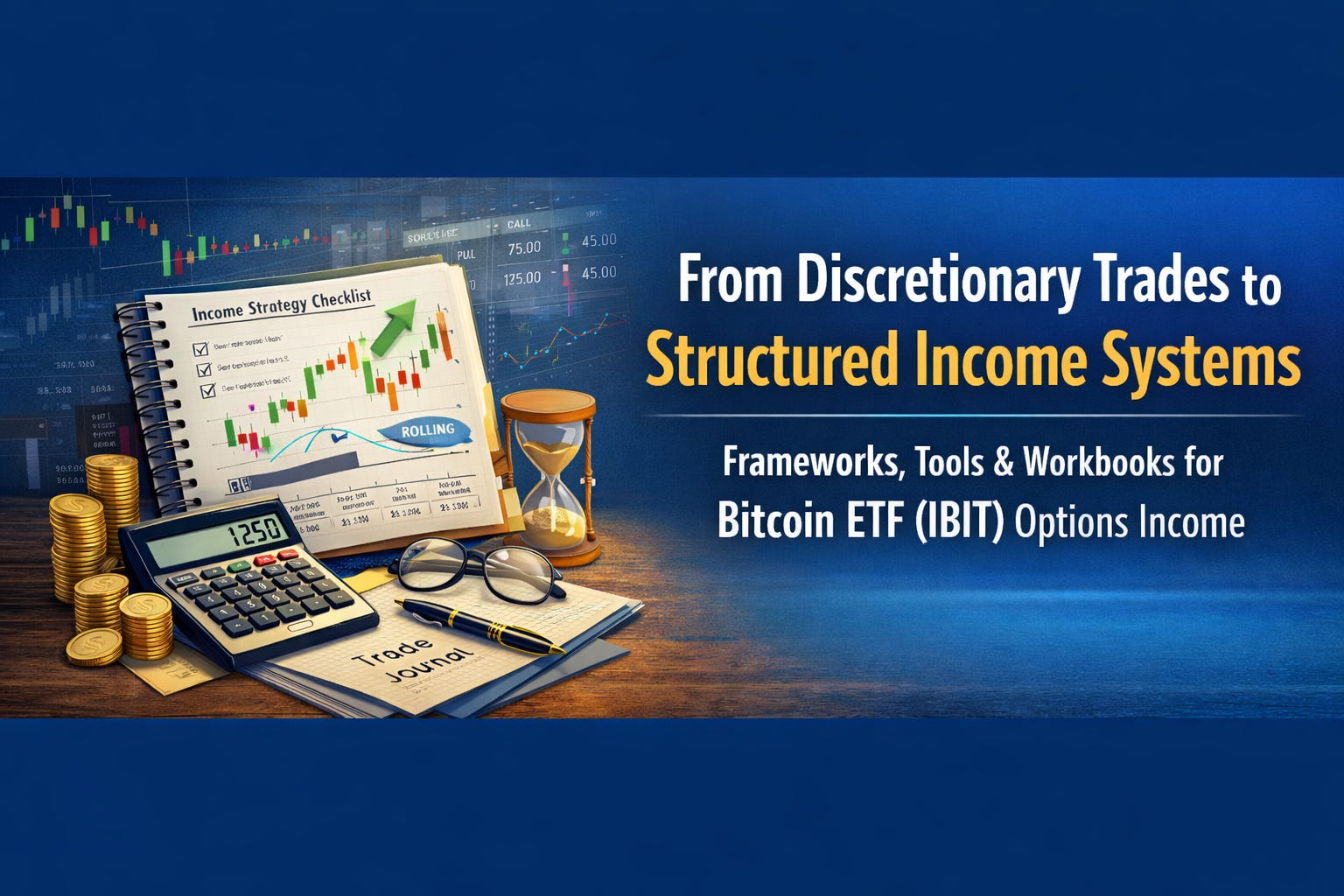
Over the past decade, the democratization of derivatives markets has empowered self-directed investors with access to sophisticated income strategies once reserved for institutional desks. Yet access alone has not solved the core problem: most market participants still operate without a repeatable decision architecture. They rely on isolated trade ideas, scattered indicators, or reactive responses to volatility. The result is inconsistent income, uneven risk exposure, and decision fatigue across changing market regimes.
What distinguishes a mature options-income approach is not the complexity of the strategy, but the structure surrounding it. A disciplined framework integrates volatility context, strike selection logic, capital allocation boundaries, and forward income modeling into a coherent workflow. This is the intellectual premise behind the research and educational ecosystem presented across the EarnSideIncome platform and its companion resources. The emphasis is not on predicting market direction, but on designing a rules-based process that allows investors to evaluate premium-selling opportunities systematically - across bull trends, corrections, and prolonged sideways markets.
The Strategic Value of a Rules-Based Income Architecture
Options-income strategies such as covered calls and cash-secured puts are often introduced to retail audiences as simple yield enhancers. In practice, however, their effectiveness depends heavily on timing discipline, implied volatility context, and portfolio-level exposure management. Without structured guardrails, these strategies can easily devolve into reactive trades that overemphasize premium while underweighting risk asymmetry.
A robust framework therefore reframes options income as a portfolio engineering exercise rather than a trade-by-trade tactic. Strike selection becomes a probabilistic decision tied to delta targeting and volatility percentile ranges. Rolling decisions evolve into capital-efficiency judgments based on remaining extrinsic value and forward opportunity cost. Position sizing transitions from arbitrary lot selection to a risk-budgeted allocation process aligned with overall portfolio objectives.
By embedding these principles into calculators, scenario models, and trade-planning templates, the platform effectively converts discretionary judgment into structured analysis. This shift is subtle but profound: it moves the investor from asking, “Is this trade attractive?” to asking, “Does this trade meet the predefined framework criteria under current volatility and market structure conditions?”
The Book as an Execution-Oriented Practitioner Guide
Within this ecosystem, the flagship book serves as the conceptual anchor - a practical playbook that demystifies options-based income strategies through a structured, workflow-driven lens. Rather than presenting strategies as isolated tactics, it integrates them into a unified process spanning entry evaluation, premium capture optimization, rolling mechanics, and ongoing exposure monitoring.
Covered calls are examined not merely as yield overlays, but as instruments whose effectiveness varies across volatility regimes and trend persistence conditions. Cash-secured puts are positioned as capital deployment tools that allow investors to define acquisition prices while being compensated for providing liquidity during market pullbacks. Rolling frameworks are treated as dynamic capital reallocation decisions that must weigh incremental credit, time decay, and revised probability distributions.
The book’s practical value emerges from its emphasis on execution discipline. Step-by-step checklists, position-sizing logic, and forward income projection models create a structured pre-trade and post-trade evaluation loop. This encourages investors to adopt a repeatable decision cadence - review volatility context, evaluate strike probability, size exposure, monitor evolving conditions, and adjust systematically. Such discipline reduces emotional biases that often arise during rapid market swings, enabling more consistent outcomes over time.
Tools, Calculators, and Workbooks as Operational Infrastructure
Education alone rarely changes investor behavior; operational tools do. The integration of calculators, projection models, and trade-tracking workbooks transforms conceptual understanding into executable process. These tools allow investors to quantify premium yield relative to position value, simulate assignment scenarios, compare rolling alternatives, and model cumulative income potential over multi-month horizons.
This modeling capability is particularly valuable in volatile asset classes where option premiums fluctuate significantly with implied volatility. Instead of reacting subjectively to premium spikes, investors can evaluate whether elevated yields compensate adequately for increased downside risk or opportunity cost. Similarly, position-sizing calculators encourage capital allocation decisions grounded in portfolio risk budgets rather than impulsive sizing based on recent trade outcomes.

Trade journals and checklists further reinforce discipline by creating an audit trail of decision rationale. Over time, such documentation supports iterative learning -highlighting which setups aligned with framework criteria and which deviated due to emotional or market-driven pressures. In institutional settings, this type of structured review process is standard practice; bringing similar rigor to self-directed portfolios represents a meaningful advancement in retail derivatives education.
Live Workflow Demonstrations and Scenario-Based Learning
Complementary educational modules and scenario walkthroughs extend this framework into applied learning environments. Observing how strategies are executed step-by-step within a live brokerage context provides clarity on decision sequencing - when to select strikes, how to evaluate expiration cycles, and how to adjust positions when market conditions shift. The pedagogical value lies not in the specific trade example, but in understanding the decision logic that governs each action.
Similarly, alert-style analytical updates serve as contextual overlays rather than signals in isolation. By framing opportunities within volatility regimes, delta targeting ranges, and macro market structure considerations, these resources aim to cultivate investor judgment rather than replace it. The goal is to help participants internalize the framework so that, over time, they can independently evaluate setups with similar rigor.
Compliance, Responsibility, and the Educational Mandate
From a governance perspective, the platform consistently emphasizes that all materials are educational and informational in nature. This distinction is critical. Options-income strategies inherently involve trade-offs between premium collection, downside exposure, and foregone upside participation. No framework eliminates risk; it only structures how risk is evaluated and managed. Encouraging suitability assessment, prudent capital allocation, and independent due diligence aligns the educational mission with responsible market participation standards.
Such positioning also reflects a broader industry evolution: the recognition that investor education must move beyond theoretical explanations toward practical decision infrastructures that mirror institutional risk management practices. When self-directed investors adopt structured workflows supported by quantitative tools and documented checklists, they narrow the behavioral gap that historically separated retail execution from professional portfolio management.
Concluding Perspective: Institutional Discipline for Self-Directed Portfolios
Ultimately, the enduring value of this integrated ecosystem-spanning the book, analytical tools, structured templates, and scenario-based modules-lies in its attempt to institutionalize retail decision-making. It reframes options-income generation from a sequence of opportunistic trades into a disciplined, model-guided process adaptable to varying market conditions.
For practitioners, the takeaway is not merely the adoption of specific strategies, but the cultivation of a systematic mindset: evaluate volatility context before selling premium, size positions within defined risk budgets, document rationale, and review outcomes against framework criteria. Over extended market cycles, this approach fosters consistency, reduces emotional decision-making, and supports sustainable portfolio income objectives grounded in structured analysis rather than speculation.
IMP: End of Universal Crypto Cost Basis. Wallet-by-Wallet Crypto Tax Tracking Starts in 2025 (File in 2026)
Author: Crypto Exponentials - decoding the intersection of regulation, markets, and decentralized infrastructure.