

The Financial Operating System Is Being Rewritten
Bitcoin. Tokenization. AI Agents. Regulatory Clarity.

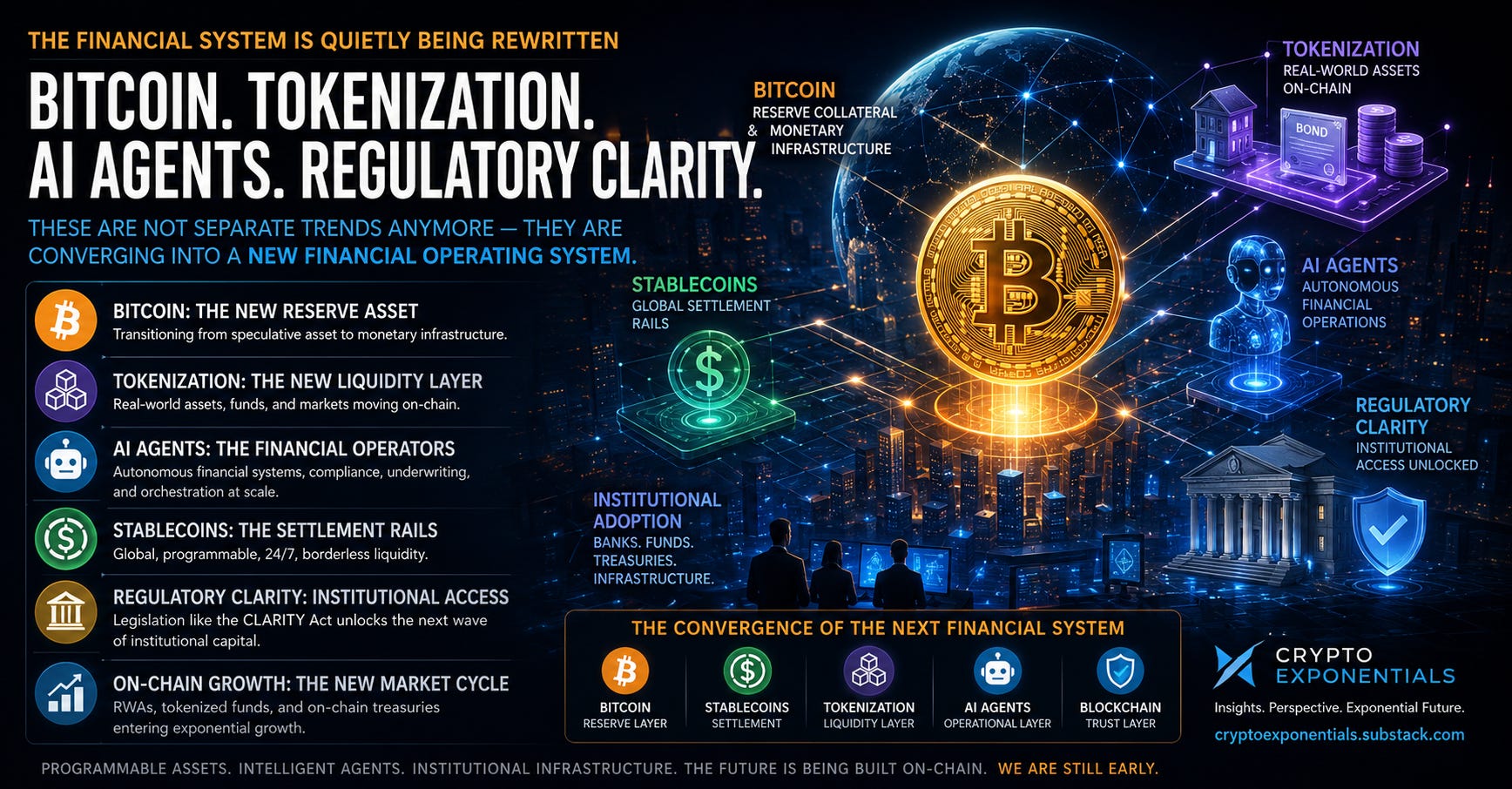
These are not separate trends anymore. They are converging into a new financial operating system - and most investors are still analyzing them in isolation.
The market is still debating whether crypto is “back.”
Institutional capital has already moved to the next phase.
While retail watches price candles, the infrastructure layer of global finance is being rebuilt in real time: JPMorgan launching tokenized money market infrastructure. Bitcoin evolving into global reserve collateral. AI agents entering financial workflows. The CLARITY Act advancing through Senate markup - yesterday. On-chain real-world assets exploding in growth.
This is no longer a speculative side narrative.
This is the emergence of programmable finance.
📡 Five Signals This Week
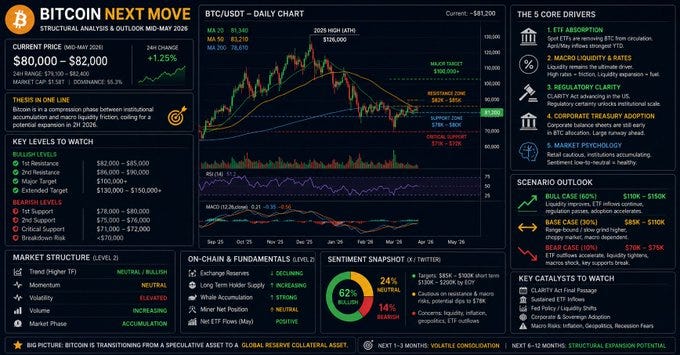
BTC/USD: ~$81,200 · +1.25% 24H
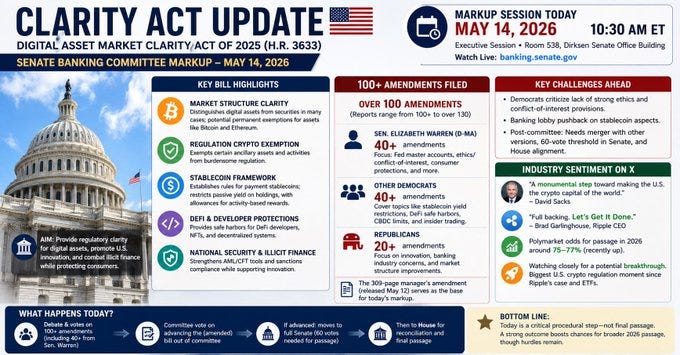
CLARITY Act: Senate Banking Committee Markup - May 14, 2026, 10:30 AM ET
JPMorgan JLTXX: Second tokenized money market fund filed on Ethereum
Bernstein Target: $150K Bitcoin tied to tokenization supercycle
Kelly Models: Long-horizon BTC allocation: 65–70%
1. Bitcoin Is Transitioning From Speculative Asset → Monetary Infrastructure
For years, Bitcoin was treated as a trading asset. A macro hedge. A volatile risk-on instrument.
That framework is becoming incomplete.
What we are witnessing now is the gradual transformation of Bitcoin into:
Reserve collateral
Treasury infrastructure
Settlement assurance
Long-duration pristine digital capital
The important shift is not price. The important shift is market role.
Bitcoin volatility has structurally compressed relative to prior cycles while institutional ownership continues expanding through ETFs, treasury strategies, and sovereign-level discussions. Analysts at Bernstein recently projected a $150K Bitcoin scenario tied to the broader tokenization cycle.
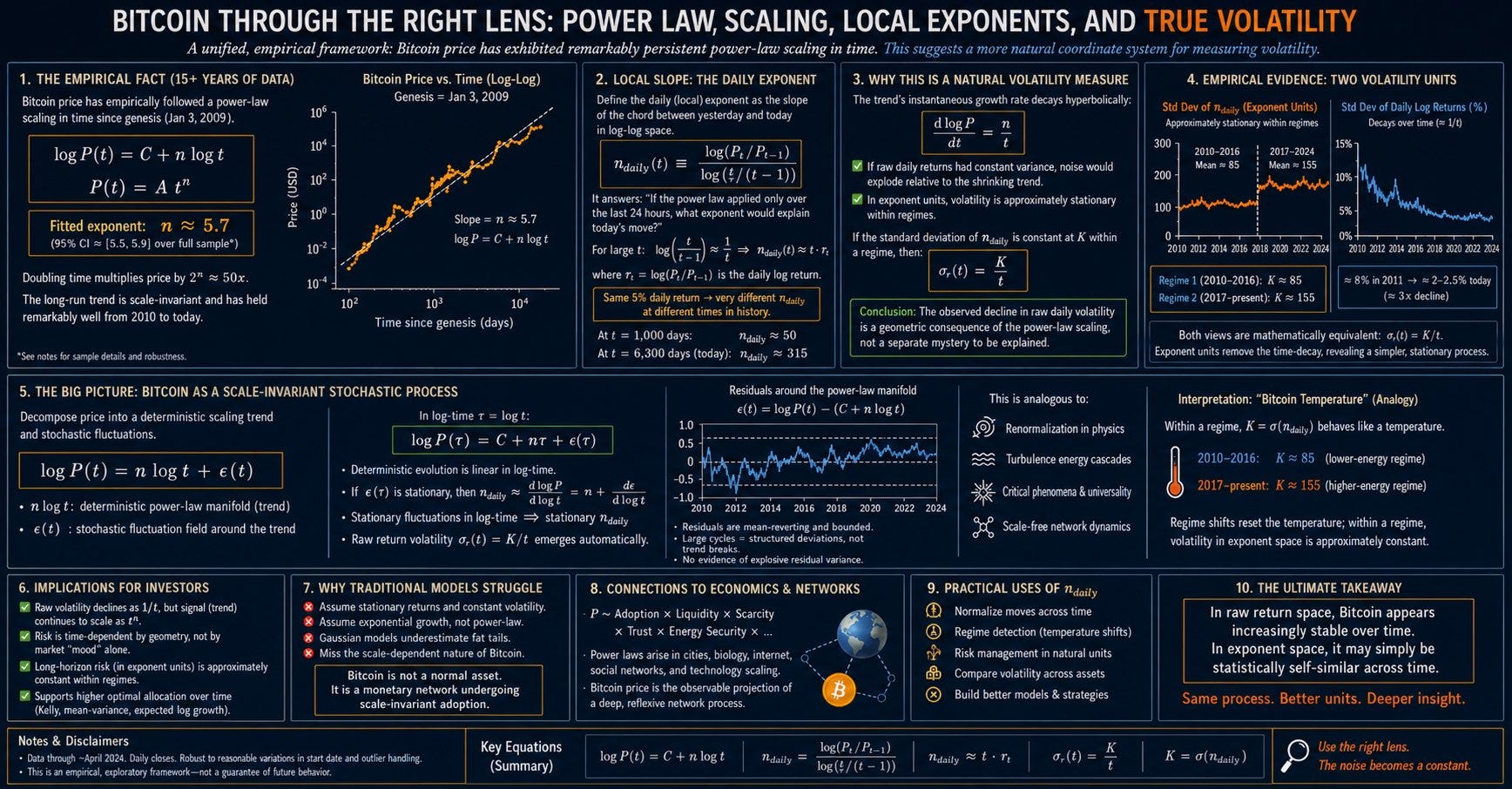
Power law analysis of 15+ years of on-chain data shows Bitcoin’s log-price scaling with exponent n ≈ 5.7 - and that fit has held remarkably well from 2010 to today.
Bitcoin increasingly behaves less like a startup technology asset and more like a neutral monetary layer.
That changes everything downstream.
2. Tokenization Is Becoming the New Liquidity Layer of Global Finance
This may be the most important structural shift happening in finance today.
Tokenization is no longer theoretical experimentation. It is moving into production.
JPMorgan just filed for its second tokenized money market fund — JLTXX on Ethereum. Key details: fees of ~16bps, stable NAV, 24/7 settlement, programmable collateral, near-instant transfers, on-chain treasury management.
Traditional finance operates on fragmented, slow-moving infrastructure — settlement delays, intermediaries, capital inefficiencies, geographic friction, limited market hours.
Tokenization changes the architecture itself. Assets become:
Programmable
Composable
Globally transferable
Fractionalized
Continuously liquid
Banks aren’t asking “will tokenization matter?” anymore.
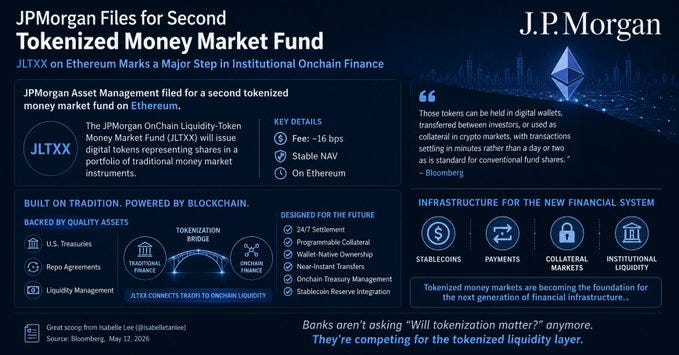
They are competing for the tokenized liquidity layer.
“Those tokens can be held in digital wallets, transferred between investors, or used as collateral in crypto markets, with transactions settling in minutes rather than a day or two.” — Bloomberg
3. AI Agents Are Becoming Financial Operators
Most people still think about AI through the lens of chatbots.
That framing is already outdated.
The next phase is agentic financial infrastructure — AI systems capable of underwriting, compliance analysis, reporting, portfolio monitoring, due diligence, KYC/AML workflows, and autonomous financial orchestration.
At Crypto Exponentials, we believe the bottleneck is no longer the intelligence layer alone. The bottleneck is orchestration, governance, verifiability, and trust infrastructure.
This is where blockchain and AI begin to converge naturally:
AI requires: provenance · auditability · coordination · incentive alignment
Blockchains provide: immutable records · programmable ownership · transparent execution · decentralized coordination
The convergence is inevitable.
One important caution: recent academic research warns that many “AI crypto” projects simply wrap centralized architectures with token layers without solving genuine decentralization problems. The winners will not be meme narratives. The winners will build verifiable infrastructure, agent coordination layers, decentralized compute, and institutional-grade AI rails.
4. The CLARITY Act: Today Is a Critical Day
The Digital Asset Market Clarity Act of 2025 (H.R. 3633) passed the House on July 17, 2025 with a strong bipartisan 294–134 vote - the most comprehensive crypto legislation ever to clear one chamber of Congress.
Yesterday - May 14, 2026 at 10:30 AM ET - the Senate Banking Committee holds its markup session. Over 100 amendments have been filed. This is a critical procedural step, but not final passage. The bill still needs to clear the full Senate before heading to the President’s desk.
Key challenges remain:
Democrats pushing back on stablecoin yield provisions
Banking lobby opposition on several aspects
A 60-vote threshold needed in the full Senate
Limited legislative calendar - meaningful progress must happen before the July recess or comprehensive digital asset legislation could slip to 2027
Polymarket currently assigns a 67% probability of the CLARITY Act passing in 2026.
Markets often misunderstand regulation.
Good regulation does not kill industries. Good regulation unlocks institutional participation.
Institutional capital requires legal clarity, compliance pathways, custody certainty, and enforceable frameworks. Once those exist - capital allocation models change. That is why tokenization, stablecoins, and regulated on-chain infrastructure are accelerating simultaneously - regardless of whether this specific bill crosses the finish line this year.
Industry sentiment: “A monumental step toward making the U.S. the crypto capital of the world.” - David Sacks
5. Information Theory Says Bitcoin Allocation Should Be Higher Than You Think
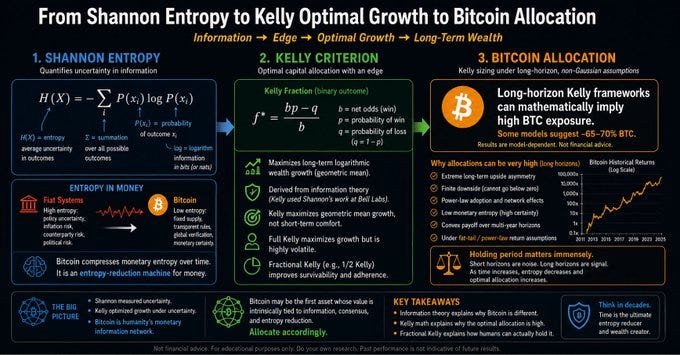
Shannon entropy quantifies uncertainty in information systems.
Kelly’s criterion - derived from information theory - maximizes long-term logarithmic wealth growth when you have an edge.
Applied to Bitcoin’s power-law return structure and extreme upside asymmetry, long-horizon Kelly frameworks suggest allocations of 65–70% BTC for investors with multi-decade time horizons.
Why allocations can be this high:
Extreme long-term upside asymmetry
Finite downside (cannot go below zero)
Power-law adoption and network effects
Low monetary entropy (high certainty of direction)
Convex payoff over multi-year horizons
The key insight: as holding periods increase, entropy decreases and optimal allocation increases.
Time is the ultimate entropy reducer. Bitcoin is humanity’s monetary information network.
Think in decades, not quarters.
The Bigger Picture: One Emerging Stack
Layer Component Function 5 AI Agents Operational layer 4 Tokenization Liquidity abstraction 3 Stablecoins Settlement rails 2 Bitcoin Reserve collateral 1 Blockchain Trust & coordination
Bitcoin, AI, tokenization, stablecoins, and regulation are not isolated megatrends.
They are becoming components of the same emerging system.
Most investors are analyzing these sectors independently. But the real opportunity exists at the intersections. That is where exponential shifts usually happen.
Final Thought
The next cycle may not be defined by which token pumps the hardest.
It may be defined by who controls liquidity, who owns distribution, who orchestrates intelligent financial agents, and who builds the infrastructure connecting AI, capital, and programmable assets.
The market is no longer asking:
“Will blockchain matter?”
The market is beginning to ask:
“Which parts of finance will not become programmable?”
We are still early. The direction is increasingly visible.
Not financial advice. For educational purposes only.
=================
The DeFi Income Playbook
Tired of DeFi hype with zero execution?
The DeFi Income Playbook just dropped:
📘 15 chapters
⚡ 34 step-by-step walkthroughs
🌐 26 real protocols across 6 chains
Learn real yield strategies, risk frameworks, and delta-neutral basis trades targeting 8–12% monthly opportunities.

Includes:
✔ Aave
✔ Uniswap V3
✔ Curve/Convex
✔ Hyperliquid
✔ Stablecoin yield systems
🎁 FREE Bitcoin ETF Options bonus included.
Instant PDF download - just $19.95 👇
DeFi Income Playbook: https://earnsideincome.net/defi